Spring Activity Book for Kids Vol-1
If you're creating children’s activity books for print or digital platforms—or building a KDP publishing business—the Spring Activity Book for Kids Vol-1 offers a rare combination of flexibility, quality, and ready-to-deploy content. It’s not just another collection of seasonal pages; it's a production-ready interior designed to support creators who value time, consistency, and creative control.
What Makes This Interior Stand Out for Publishers & Educators
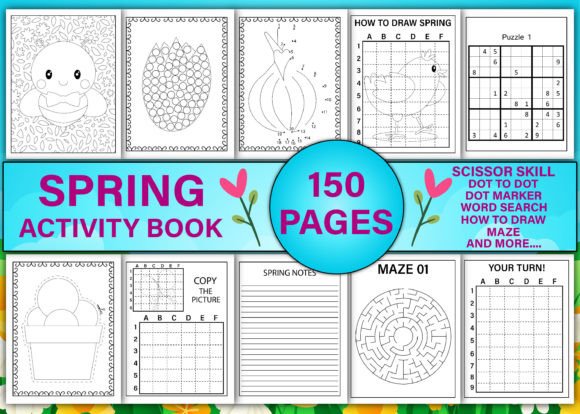
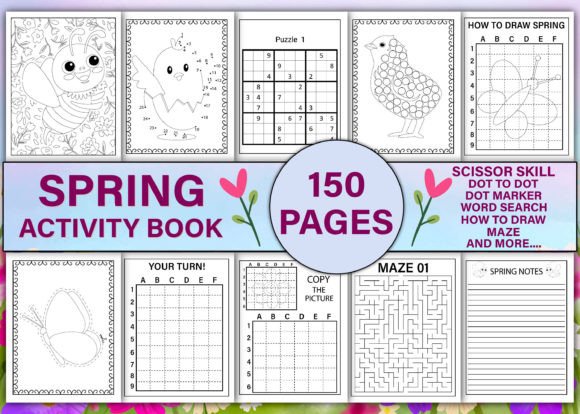
This volume delivers 150 distinct, high-resolution activity pages—each crafted with developmental appropriateness in mind and formatted for real-world use. Unlike generic clipart bundles or low-res PDFs, every page is built at A4 (8.5″ × 11″) with full bleed, meaning no awkward white borders when printed professionally. The inclusion of layered Adobe Illustrator (.ai) source files gives you true editorial agency: adjust colors, resize elements without pixelation, reposition layouts, or swap fonts—all without starting from scratch.
For educators designing classroom spring units, the variety matters: dot-to-dot pages reinforce number sequencing and fine motor coordination; scissor skills sheets build hand strength and bilateral coordination; “copy the picture” exercises support visual memory and spatial reasoning. Meanwhile, mazes and puzzles encourage logical thinking, while “how to draw” prompts nurture confidence in early artistic expression. Even the “Spring Notes” section—often overlooked in activity books—offers clean, labeled space for journaling, vocabulary building, or nature observation logs.
Why Format Flexibility Translates to Real-Time Savings
Time isn’t just saved by having 150 pages—it’s saved by how those pages are delivered. You receive not one but three usable formats: editable AI files, print-ready PDFs (CMYK-optimized), and individual 300 DPI PNG/JPG assets. That means no tedious extraction from flattened PDFs or guessing at layer structure. If you’re preparing a KDP upload, the PDFs go straight to Amazon with no preflight surprises. If you're adapting for a bilingual edition or adding custom instructions, the AI files let you edit text boxes, adjust line weights, or isolate elements for translation overlays.
Freelance designers often spend hours sourcing, resizing, and standardizing assets across a 150-page book. Here, consistency is baked in: uniform margins, consistent stroke weights, balanced negative space, and cohesive spring-themed iconography (butterflies, blossoms, rainbows, garden tools) that feel intentional—not pieced together. That cohesion builds brand trust, especially if you plan to release seasonal volumes as a series.
Who Benefits Most—and How They Use It
Publishers building KDP catalogs appreciate that this interior meets Amazon’s technical requirements out of the box—bleed, resolution, color mode, and file naming conventions are all aligned. One creator used the PNG set to generate social media teasers, email newsletter previews, and even animated flip-through videos—without licensing concerns, since all assets are fully licensed for commercial use.
Educators and homeschoolers find value in the modularity: they pull single pages for morning warm-ups, therapy sessions, or rainy-day kits. The dot marker pages, for instance, work well with bingo daubers or stickers—ideal for students with limited pencil control. Scissor skills pages include varied line complexity (curves, zigzags, loops), letting instructors scaffold difficulty based on individual readiness.
Small business owners creating printable shops use the 150 PNGs to build themed bundles—e.g., “Spring Fine Motor Pack” or “Early Learner Nature Journal”—without needing illustration skills. Because each image is isolated and transparent-background (PNG), they drop cleanly into Canva templates or Notion dashboards.
A Note on Fit and Intentional Use
This isn’t a plug-and-play cover-to-cover solution for every audience. It assumes you’ll pair it with your own cover design, marketing copy, and age-targeting strategy. While pages span ages 3–8, some activities (like multi-step mazes or detailed “how to draw” guides) lean toward the upper end of that range. If your focus is toddlers under age 4, you may want to supplement with simpler tracing or sensory-based pages—not included here.
Also worth noting: while the AI files allow deep customization, they require Adobe Illustrator (or compatible software). Users unfamiliar with vector editing may find the PDF version more immediately accessible. And although all pages are spring-themed, they avoid overused tropes (no cartoon bunnies holding eggs)—favoring botanical motifs, weather patterns, insect life cycles, and garden ecosystems instead. That subtle distinction helps differentiate your product in a crowded niche.
Practical Tips for Getting Started
- Start small: Test 10–15 pages in a low-cost KDP paperback before committing to a full-color hardcover run. Monitor customer feedback on clarity, age suitability, and paper compatibility (some coloring pages perform better on thicker stock).
- Leverage the PNGs beyond print: Convert select pages into interactive PDFs using free tools like PDFescape—add fillable fields for “Spring Word List” or embed audio links for phonics practice.
- Repurpose thoughtfully: Turn maze solutions into answer keys for teachers; extract butterfly outlines for science unit flashcards; use dot-to-dot sequences as number recognition drills in intervention groups.
- Check regional expectations: In markets where A4 dominates (UK, EU, Australia), the provided dimensions align perfectly. For US-centric KDP paperbacks, confirm trim size compatibility—some printers default to 6″ × 9″, so minor cropping may be needed unless you choose 8.5″ × 11″ as your final trim.
The Spring Activity Book for Kids Vol-1 doesn’t promise viral success or passive income. What it does offer is reliability: predictable file behavior, developmentally grounded content, and professional-grade assets that scale with your goals—whether you’re launching your first KDP title, supporting a classroom of diverse learners, or expanding your printable shop with seasonal relevance. When your priority is quality execution—not just quantity—the difference shows in how smoothly your project moves from concept to shelf.