Valentine’s Activity Book for Kids Vol-1: A Strategic Asset for Creators and Educators
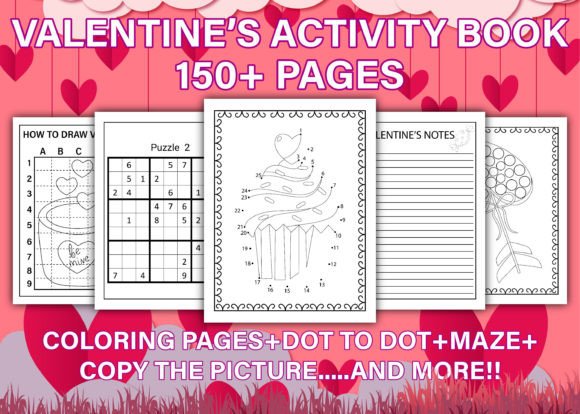
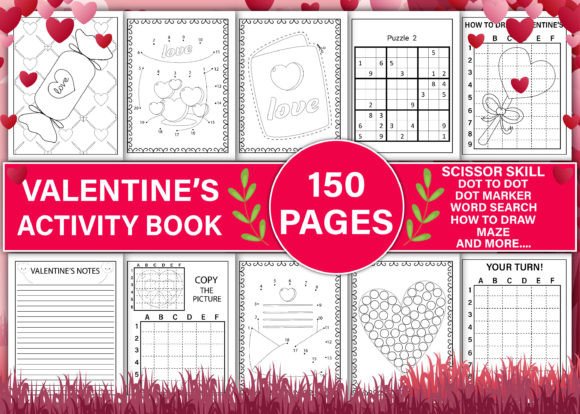
Valentine’s Activity Book for Kids Vol-1 isn’t just another themed printable—it’s a purpose-built, production-ready resource engineered for scalability, brand alignment, and real-world execution. With 150 distinct interior pages—each delivered in AI, PDF, PNG, and JPG formats—and full A4 (8.5″ x 11″) print specifications including bleed and high-resolution output, this collection bridges creative vision with operational readiness. It’s designed not for passive consumption, but for intentional deployment across multiple business and educational contexts.
Why This Isn’t Just Another Coloring Book
Most activity books offer isolated engagement. Valentine’s Activity Book for Kids Vol-1 delivers layered utility. Each of the 150 pages serves a defined developmental or production function: dot-to-dot for number recognition and sequencing, dot marker pages for fine motor control, scissor skills layouts for hand-eye coordination, coloring pages for emotional regulation and color theory exposure, “how to draw” guides for sequential thinking, mazes for problem-solving stamina, copy-the-picture exercises for visual memory, and Valentine’s Notes for early literacy and social-emotional practice. That diversity isn’t accidental—it’s strategic scaffolding. When you choose a page type, you’re selecting a specific learning objective or customer outcome—not just filling space.
Strategic Use Cases Across Audiences
For KDP publishers and indie authors, Valentine’s Activity Book for Kids Vol-1 accelerates time-to-market without sacrificing quality. The inclusion of editable AI source files means you can adjust fonts, swap clipart, localize language, or integrate your brand palette—without starting from scratch. You’re not licensing static assets; you’re acquiring editable building blocks. One creator used the “How to Draw” section as the foundation for a companion YouTube series, embedding short tutorials that drove traffic back to their Amazon listing. Another educator repurposed the maze and puzzle pages into differentiated station rotations—printing only what her third-grade class needed that week, reducing prep time by 60%.
Freelancers and curriculum designers benefit from modular flexibility. Need a quick Valentine’s-themed SEL supplement? Pull the “Valentine’s Notes” pages and adapt prompts for empathy-building journaling. Building a subscription box for preschoolers? Mix and match 10 dot marker + 5 scissor skills + 3 coloring pages per shipment—no redesign required. The file structure supports selective use, not all-or-nothing adoption.
Planning Your Implementation—Not Just Printing It
Before uploading to KDP or distributing digitally, ask three questions:
- What outcome am I optimizing for? Is it speed-to-market? Brand consistency? Differentiation in a saturated niche? If your goal is visibility on Amazon, prioritize cover design, keyword-rich backend metadata, and bundling (e.g., pairing Vol-1 with a simple parent guide PDF). If your aim is classroom integration, focus on page grouping by skill domain—not chronological order.
- Where does this fit in my content architecture? Does it serve as a lead magnet, a standalone product, or part of a seasonal series? One small publisher treated Vol-1 as the anchor for a “Holiday Activity Bundle”—adding Halloween and Easter volumes later using the same layout logic and branding system. That consistency built trust and repeat purchases.
- What operational capacity do I have? High-resolution files demand storage and bandwidth. If delivering digitally, compress PNGs selectively (retain quality on line-art pages; optimize photos less relevant here). For print-on-demand, verify bleed and margin specs match your printer’s requirements—don’t assume “A4” means identical output across vendors.
Risks of Using Without Context
Without clear goals, Valentine’s Activity Book for Kids Vol-1 can become shelfware—downloaded, opened once, then forgotten. Generic use leads to generic results: a KDP listing buried under thousands of similar titles, or classroom worksheets that fail to align with district standards or student needs. Worse, indiscriminate editing—like resizing illustrations without preserving vector integrity in the AI file—can degrade print quality, damaging credibility with customers who expect professional output.
Another risk lies in misalignment between page intent and audience readiness. A “copy the picture” page assumes visual discrimination and pencil control—skills many 4-year-olds haven’t fully developed. Using it with pre-K without scaffolding may frustrate learners instead of supporting growth. Similarly, assigning complex mazes to early elementary students without modeling strategy first turns practice into avoidance. Intentional use means matching page complexity to cognitive and motor benchmarks—not just age ranges.
Branding, Positioning, and Long-Term Value
Your brand isn’t defined by what you sell—but how you solve problems. Valentine’s Activity Book for Kids Vol-1 becomes a credibility amplifier when positioned around outcomes: “Build fine motor skills before kindergarten,” “Strengthen focus during winter months,” or “Support inclusive social-emotional learning through seasonal themes.” That framing shifts perception from “cute printable” to “purpose-built tool.”
Long-term value emerges when you treat the book not as a one-off, but as infrastructure. Save your edited AI files with version numbers and notes (“Vol-1-BrandBlue-Edits-2024”). Document which pages perform best—do dot markers drive more email signups than coloring pages? Does the “How to Draw” section generate higher engagement on Pinterest? Track those patterns. Over time, you’ll identify high-leverage templates to replicate in future volumes—creating a scalable content engine, not just a seasonal product.
Practical Integration Tips
Start small. Pick one page type—say, scissor skills—and test it in two contexts: once as a no-prep KDP interior, once adapted as a free download for your email list. Compare conversion rates, open rates on follow-up emails, and support queries. Let data—not assumptions—guide expansion.
When editing, protect resolution integrity. Resize within Illustrator using “Object > Transform > Scale” (not dragging corners), and always export new PDFs at 300 DPI with CMYK color mode for print. For digital use, export PNGs at 150 DPI—smaller file size, faster load times, no perceptible loss for screen viewing.
Consider bundling beyond holidays. One educator combined five “Valentine’s Notes” pages with blank templates and turned them into a “Kindness Journal Starter Kit”—positioned year-round for character education. Another freelancer embedded three maze pages into a client’s therapy workbook for children with ADHD, citing research on sustained attention tasks. Context transforms utility.
Final Strategic Note
Valentine’s Activity Book for Kids Vol-1 succeeds only when matched with deliberate decision-making—not just creative impulse. It rewards planners, not just producers. It scales for entrepreneurs who document workflows, educators who align resources to standards, and creators who see each page as a node in a larger system of learning, engagement, or revenue. Don’t reach for it because it’s available. Reach for it because it solves a specific, well-defined challenge—and because you’ve already decided how success will be measured, communicated, and extended beyond the first download.