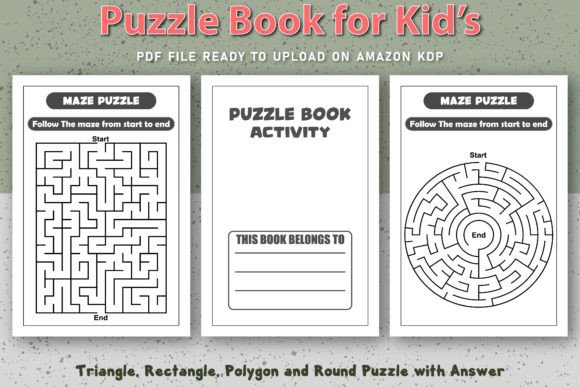
Animals Mazes for Kids 3-5 Activity Book
For early childhood educators, homeschooling parents, and creative entrepreneurs building digital product libraries, the Animals Mazes for Kids 3–5 Activity Book represents more than just a collection of puzzles—it’s a responsive, print-ready tool aligned with how young children learn, how caregivers support development, and how creators distribute meaningful resources in today’s digital-first landscape.
Why Simple Mazes Matter at Age 3–5
Between ages three and five, children are refining foundational cognitive and motor skills: visual tracking, spatial reasoning, impulse control, and fine motor precision. Mazes—especially those designed with thick lines, clear animal themes, and uncluttered pathways—offer low-stakes practice in decision-making and sequential thinking. Unlike flashcards or timed drills, mazes invite sustained attention through play. A child tracing a path from a lion to its cave isn’t just “filling time”; they’re strengthening neural pathways tied to planning, prediction, and hand-eye coordination—all while smiling at a friendly elephant or giggling at a waddling penguin.
This isn’t theoretical. Research in early childhood education consistently links purposeful play with improved executive function. What makes the Animals Mazes for Kids 3–5 Fun and Educational Printable Activity Book effective is its intentional design: single-sided pages eliminate confusion for little hands flipping paper, no-bleed margins ensure clean cuts when trimming, and high-resolution interiors preserve clarity even after repeated printing. It meets developmental needs without overcomplicating the experience.
How Printables Fit Into Modern Parenting and Teaching Workflows
Today’s caregivers juggle screen time concerns, limited prep time, and rising expectations for educational enrichment. A physical, screen-free activity that requires only paper and a pencil—and can be printed on demand—isn’t just convenient; it’s a strategic choice. Parents use these mazes during quiet mornings, car rides (with laminated versions), or as calm-down tools after energetic play. Preschool teachers integrate them into center rotations, morning baskets, or take-home learning packets—no login, no device, no battery drain.
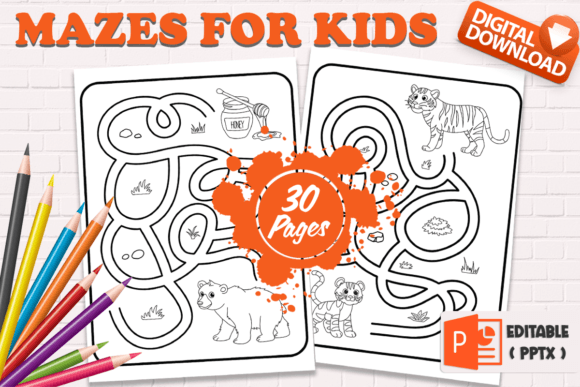
That practicality extends to educators adapting to hybrid models. With many classrooms maintaining flexible schedules or rotating cohorts, having a ready-to-print resource means less time sourcing materials and more time engaging children. And because the file includes both PDF and 30 individual PNGs, it supports multiple uses: embedding in digital lesson plans, uploading to learning management systems, or adapting for interactive whiteboards using annotation tools.
A Creator-Friendly Format for Digital Product Sellers
For designers, illustrators, and small-business owners selling on print-on-demand (POD) platforms like Amazon KDP, Etsy, or Creative Market, the technical specs of this activity book reflect current best practices. The 8.5×11 inch size matches standard US letter paper and most POD templates. Single-sided layout avoids bleed-through issues common with thin paper stock. The inclusion of PNG files alongside the master PDF allows for easy customization—adding a logo to a cover, inserting a custom title page, or rebranding for a subscription box service.
Crucially, the file is optimized for Adobe Acrobat, a free and widely adopted tool. No specialized software is required to print, scale, or batch-generate copies. This lowers the barrier for non-technical users—grandparents printing for grandchildren, volunteer tutors preparing classroom kits, or boutique childcare centers creating branded learning kits. That accessibility directly supports wider adoption and repeat use.
From Trend to Tool: Why Animal-Themed Mazes Are Resonating Now
Animal themes aren’t arbitrary. They tap into a well-documented developmental preference: young children connect more readily with familiar, expressive characters—especially those with distinct features, sounds, and movements. A maze shaped around a giraffe’s long neck or a turtle’s slow-but-steady journey supports narrative thinking and vocabulary building alongside problem-solving. It also aligns with growing interest in nature-based learning and social-emotional themes like patience, persistence, and kindness toward living things.
Simultaneously, the rise of “slow parenting” and intentional screen limits has renewed demand for tactile, open-ended activities. Mazes fit neatly here—not prescriptive, not outcome-driven, but rich in process. There’s no single “right answer” beyond reaching the end; the value lies in trial, adjustment, and self-correction. That mirrors broader shifts in education: away from standardized completion metrics and toward observable growth in focus, resilience, and curiosity.
Real-World Use Cases Across Roles
- Educators: Use one maze per week as part of a “Focus Friday” routine—pair it with a short animal fact, a related movement game (e.g., “walk like a kangaroo”), and a drawing extension.
- Homeschoolers: Combine mazes with sensory bins (e.g., hide animal figurines in rice and match them to maze animals) to layer learning modalities.
- Therapists & OTs: Leverage the consistent line weight and spacious layout to support pencil grip development and visual scanning exercises—especially helpful for children working on attention regulation.
- Content Creators: Repurpose individual PNGs into Instagram carousels (“Maze Monday”), printable newsletter bonuses, or bite-sized challenges for email list growth.
- Small Business Owners: Bundle the activity book with plush animal toys, nature-themed stickers, or seed packets to create cohesive, values-aligned gift sets.
What’s Changed—and What Hasn’t
While digital apps for kids have multiplied, their limitations remain visible: eye strain, passive interaction, and unpredictable ad exposure. Meanwhile, research continues to affirm the unique benefits of analog, self-paced tasks—particularly for children under six. What’s evolved is not the need for such tools, but how easily they can be accessed, adapted, and scaled. Ten years ago, sourcing high-quality, developmentally appropriate printables often meant sifting through inconsistent downloads or paying premium subscriptions. Today, a single-click instant download—delivered to your inbox, usable across devices, and fully editable—reflects a maturing ecosystem where quality and convenience coexist.
The Animals Mazes for Kids 3–5 Activity Book doesn’t try to replace technology. Instead, it offers balance—a reliable, joyful, and pedagogically grounded option that fits seamlessly into routines already shaped by busy schedules, diverse learning needs, and evolving expectations for what “educational” truly means.
Getting Started Is Intentional, Not Complicated
There’s no setup fee, no subscription, and no waiting for shipping. Once payment is confirmed, the download link arrives instantly—sent to the email used at checkout. From there, open the PDF in Adobe Acrobat (free), select your printer settings, and go. Need five copies for a preschool class? Print five. Want to test one maze before committing? Print just page three. The flexibility is built-in—not as a feature, but as a reflection of real-world use.
And because the file is yours to keep and reuse, it supports sustainability in practice: no wasted inventory, no over-ordering, no landfill-bound packaging. For creators building ethical, scalable product lines—or parents seeking low-waste learning tools—it’s a detail that quietly matters.
Final Thought: Tools That Grow With Their Users
The most enduring educational resources don’t shout. They serve. They adapt. They respect the learner’s pace—and the adult’s time. The Animals Mazes for Kids 3–5 Fun and Educational Printable Activity Book does exactly that: it meets children where they are, supports adults with clarity and ease, and gives creators a foundation they can build upon—not around. In a world pulling in many directions, sometimes the most forward-looking choice is the simplest one: a well-designed maze, an animal waiting at the end, and a child figuring out the way—step by careful step.