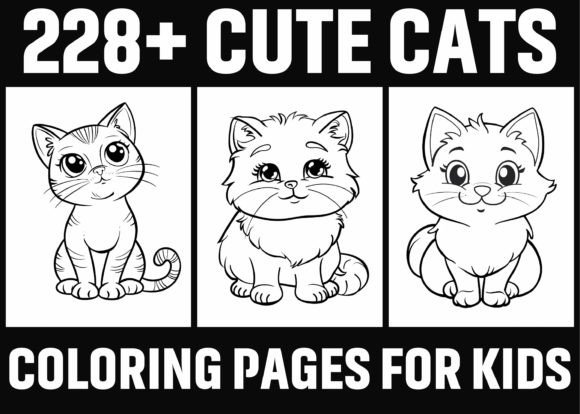
228 Cute Cats Coloring Pages for Kids
For creators, educators, and small business owners building digital products with intention, 228 Cute Cats Coloring Pages for Kids is more than a bundle—it’s a versatile, production-ready asset with strategic flexibility. At its core, it delivers 228 high-resolution black-and-white cat-themed illustrations—each sized to A4 (8.5″ × 11″), optimized at 300 DPI, and provided in both JPG and PNG formats. Complementing those interiors are 70 premium book cover designs, also in PNG and scalable without quality loss. You receive everything in a single ZIP file—no subscriptions, no watermarks, no usage restrictions.
Why This Bundle Fits Real-World Creative Workflows
Unlike generic clipart packs or low-res downloads, 228 Cute Cats Coloring Pages for Kids was built for execution—not just inspiration. Its consistent sizing, resolution, and format compatibility mean minimal prep time before printing, uploading to KDP, embedding in learning platforms, or integrating into lesson plans. That consistency reduces friction in production cycles: whether you’re launching your first Amazon KDP coloring book or assembling a themed activity kit for a preschool program, the interior pages drop in cleanly. There’s no need to batch-resize, reformat, or manually adjust contrast—every image meets industry standards out of the box.
Strategic Use Cases Across Roles
- Amazon KDP Publishers: The 228-page count satisfies KDP’s minimum requirements while allowing room for front/back matter. With 70 distinct cover options, you can test visual positioning—e.g., pastel vs. bold palettes, minimalist vs. illustrated borders—without commissioning new art. Each cover scales cleanly, so you can preview multiple thumbnails before finalizing.
- Educators & Homeschoolers: These pages support fine motor development, pattern recognition, and emotional regulation—but only when used intentionally. Rather than assigning pages randomly, align them with learning goals: use symmetrical cat faces to teach bilateral coordination; choose pages with embedded shapes (hearts, stars, paw prints) to reinforce geometry vocabulary; pair coloring with storytelling prompts to build narrative fluency.
- Freelancers & Designers: Clients often request “kid-friendly” assets for branding, packaging, or educational apps. Having this bundle on hand means you can rapidly prototype mockups, create branded activity sheets for client campaigns, or offer add-on coloring content as an upsell—without licensing delays or per-use fees.
- Small Business Owners: Think beyond books. Use select pages as printable party favors, in-store activity kits, or email newsletter bonuses. One café owner used 12 cat pages as “color-and-cupcake” take-home kits—driving repeat visits and social shares. The key wasn’t volume; it was purposeful curation aligned with audience behavior.
Planning Your Approach: What to Decide Before You Download
Access to 228 pages doesn’t guarantee impact—clarity of purpose does. Before opening the ZIP file, ask yourself three questions:
- What outcome am I optimizing for? Is it revenue (e.g., fast KDP launch), engagement (e.g., classroom participation), brand differentiation (e.g., unique merch), or operational efficiency (e.g., reducing design overhead)? Each goal shifts how you prioritize pages, sequence them, or pair them with text or instructions.
- Who is the primary user—and what do they need from this experience? A 4-year-old needs large, uncluttered outlines. A 9-year-old may seek detail, repetition, or thematic variety (kittens, sleeping cats, cats in hats). If your audience spans ages, group pages by complexity—not just cuteness—and label accordingly.
- What infrastructure supports this asset? Do you have print-on-demand integration? A PDF editor that handles batch imports? A system to track which covers convert best? Without those, even premium files sit unused. Start small: pick 10 pages, one cover, and one distribution channel—then measure before scaling.
Risks of Using Without Context
Volume alone invites missteps. Launching a KDP book with all 228 pages in random order risks poor pacing and reader fatigue. Offering uncurated pages to students without scaffolding—like vocabulary lists or reflection prompts—misses developmental opportunities. And repurposing covers without checking trademark-safe elements (e.g., certain bow styles or collar patterns that resemble registered brands) introduces legal exposure.
The biggest risk isn’t technical—it’s strategic diffusion. When creators default to “more is better,” they dilute focus. One educator tested two versions of a summer reading packet: one with 20 thoughtfully sequenced cat pages tied to weekly themes (e.g., “Cats Who Explore → Curiosity Week”), another with 60 random pages. Completion rates rose 43% with the curated version—not because the art improved, but because structure signaled value and reduced decision fatigue for both kids and parents.
How to Use 228 Cute Cats Coloring Pages for Kids Intentionally
Intentional use starts with segmentation—not just of files, but of function. Consider organizing your local copy into folders like:
- “KDP-Ready Interiors” — Pages with clean margins, balanced negative space, and minimal tiny details that won’t blur at 6″ trim size.
- “Classroom Tiered Sets” — Grouped by line weight (bold/thin), complexity (3–5 elements vs. 12+), and theme (pets, fantasy, seasonal).
- “Branding Snippets” — Single elements extracted from full pages (a paw, a curled tail, a bow) for social media icons, email headers, or product labels.
- “Cover Test Batch” — 5–7 covers pre-selected for A/B testing based on color psychology, font pairing potential, and thumbnail legibility.
This kind of organization turns a static bundle into a living resource. It also surfaces gaps: if you find yourself repeatedly wishing for more “cats with glasses” or “cats holding books,” that’s actionable insight—not for complaining about the bundle, but for planning your next custom illustration commission.
Long-Term Value Beyond the First Download
The real ROI of 228 Cute Cats Coloring Pages for Kids compounds over time—not through passive reuse, but through iterative adaptation. One children’s app developer licensed the bundle, then used 30 pages as base assets for an interactive coloring feature. Later, they commissioned 10 original illustrations in the same style to expand the library, maintaining visual continuity while differentiating their offering. Another publisher released Volume 1 on KDP, then used customer reviews (“Love the robot cats!” “Need more garden scenes!”) to guide Volume 2’s theme—proving that even pre-made assets can fuel data-informed creation.
That’s the quiet advantage: this bundle doesn’t replace strategy—it accelerates it. It lets you test assumptions faster, validate demand with lower upfront cost, and redirect energy from sourcing toward refining, positioning, and delivering. In a landscape where attention is scarce and execution speed matters, having 228 vetted, production-grade pages—and 70 cover directions—at your fingertips isn’t convenience. It’s leverage.
Use it not to fill space, but to clarify intent. Not to check a task off a list, but to advance a specific objective—one well-chosen cat page at a time.