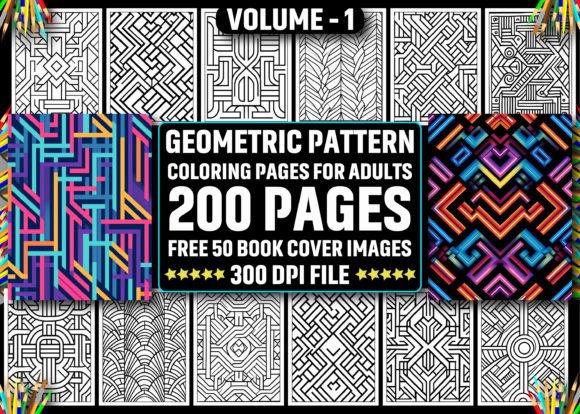
Geometric Pattern Coloring Pages
Geometric Pattern Coloring Pages are meticulously designed black-and-white line art featuring symmetrical shapes, repeating motifs, tessellations, mandalas, grids, and abstract forms rooted in mathematical precision. Unlike freehand doodles or organic illustrations, these pages emphasize balance, proportion, and structure—making them ideal for focused relaxation, creative exploration, and skill-building. Each design invites intentionality: whether you’re filling in a hexagonal honeycomb with colored pencils or digitally layering gradients over an SVG-based starburst, the geometry guides your hand and mind.
Why This Matters—Depending on Who You Are
What makes one set of Geometric Pattern Coloring Pages valuable to a graphic designer might feel overwhelming—or underwhelming—to a classroom teacher. The same file bundle can serve wildly different purposes, depending on your goals, tools, and context. Let’s break it down by real-world use cases—not job titles.
For Beginners Building Confidence
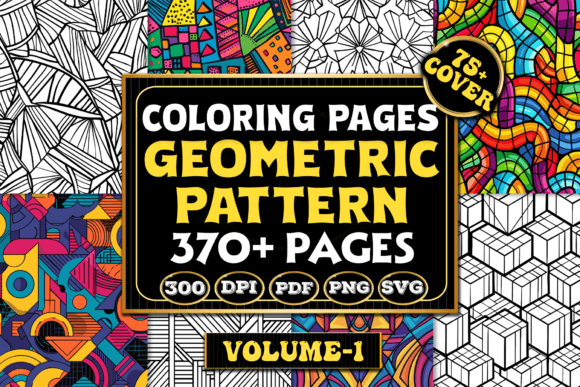
If you’re new to coloring—or returning after years—you’ll appreciate clarity over complexity. The Geometric Pattern Coloring Pages Bundle KDP Interior Volume-1 offers 370 distinct designs, many starting with open, spacious layouts and bold outlines. That means less pressure to “get it right” and more room to experiment with shading, blending, or even simple color-blocking. A beginner might print just five pages, try three different mediums (gel pens, markers, watercolor pencils), and notice how line weight affects ink bleed—or how spacing between shapes changes the rhythm of their hand movement.
For Educators and Therapists
Teachers use geometric patterns to reinforce math concepts—angles, symmetry, fractions, rotational transformations—without calling it “homework.” One middle school art teacher laminates selected pages and uses dry-erase markers to trace lines of reflection or label interior angles. A licensed counselor prints high-contrast mandala pages for grounding exercises, knowing that predictable repetition lowers cognitive load during emotional regulation. For this audience, resolution and scalability matter: the 8.5” x 11” interior files render cleanly when enlarged on a projector or shrunk into handouts—and the absence of bleed ensures no critical detail vanishes at the edge.
For Creators Building Digital Products
Designers, Canva creators, and Notion template builders treat these files like raw material. The inclusion of PNG, SVG, and PDF formats means they can drop a seamless tile pattern into a social media post (PNG), animate a rotating kaleidoscope effect (SVG), or embed vector art into a printable planner (PDF). No need to trace or redraw—just select, scale, recolor, and repurpose. One freelance educator used 12 SVGs from the bundle to build an interactive geometry lesson in Figma, letting students drag and rotate shapes to test congruence. Flexibility isn’t theoretical here—it’s baked into the file types.
For Self-Publishers and Small Business Owners
KDP authors don’t just need pages—they need production-ready assets that meet Amazon’s strict interior guidelines. The bundle delivers exactly that: 370 interiors sized to 8.5” x 11”, no bleed, black-and-white only, optimized for grayscale printing. That saves hours of resizing, testing, and reformatting. Plus, the 75 cover backgrounds aren’t filler—they’re intentional design anchors: subtle gradients, textured overlays, or minimalist frames that pair seamlessly with any title font. One indie publisher used three cover backgrounds to launch separate themed books (Calming Geometry, Sacred Symmetry, Modern Grids) without commissioning custom art.
For Hobbyists and Lifelong Learners
Not every user wants to publish or teach. Some simply enjoy the quiet discipline of coloring intersecting circles or tracing fractal branches. For them, longevity and variety matter most. The bundle’s range—from low-density dot grids to dense Islamic-inspired tessellations—means the collection grows with their interest. One retiree printed 20 pages, bound them with a spiral coil, and added handwritten notes about which patterns reminded her of tilework she’d seen in Spain. Others import single PNGs into Procreate, apply texture brushes, and share time-lapse reels—no commercial intent, just joy in process.
What to Evaluate—Beyond the Download Button
Before adding any resource to your workflow, ask: *Does this match how I actually work?*
- Ease of use: If you’re not comfortable unzipping folders or importing SVGs into design software, start with the PDFs—they open in any viewer and print instantly.
- Quality: Zoom in on a sample page. Do thin lines stay crisp at 200%? Are intersections clean—not jagged or overlapping? High-resolution interiors mean your printed book won’t show pixelation, even under close inspection.
- Flexibility: Need to recolor a motif for branding? SVG gives you editable paths. Want to add text inside a shape? PDF layers (if preserved) help—but the included PDFs are flattened for KDP compliance, so lean on PNG/SVG for customization.
- Presentation: Cover backgrounds aren’t just “extras.” They solve a real problem: finding cohesive, professional-looking covers that don’t compete with your interior art. These 75 options were designed to complement—not overwhelm—the geometric themes.
- Long-term usefulness: A single coloring page is disposable. A well-organized bundle with varied complexity, consistent formatting, and multi-format access stays useful across projects, seasons, and skill shifts.
Real Projects, Real Decisions
A freelance illustrator needed 50 unique pages for a client’s wellness app. She filtered the bundle by “low detail,” exported those as PNGs, and imported them into Adobe XD—then added subtle hover animations. No licensing headaches. No attribution required.
A homeschool parent wanted tactile math practice for her 9-year-old. She printed six pages with rotational symmetry, cut out paper shapes, and had her child rotate them over the printed designs to find matches—a hands-on extension beyond coloring.
A small studio launching a stationery line used three SVG patterns to create repeat backgrounds for greeting cards. They adjusted stroke width and spacing directly in Illustrator—no redrawing, no guesswork.
None of these users needed every file. But having 370 options meant each could find what fit—without paying for features they wouldn’t use.
Does This Fit Your Next Step?
If you’re evaluating Geometric Pattern Coloring Pages, consider where you are right now—not where you hope to be. Are you testing a coloring book idea? Then focus on the KDP-ready PDFs and cover backgrounds. Are you building digital templates? Prioritize the SVGs and PNG transparency. Are you exploring mindfulness practices? Look for pages with rhythmic repetition and breathing-room negative space.
There’s no universal “best” coloring resource. There’s only what works—clearly, quietly, and consistently—for what you’re doing today.