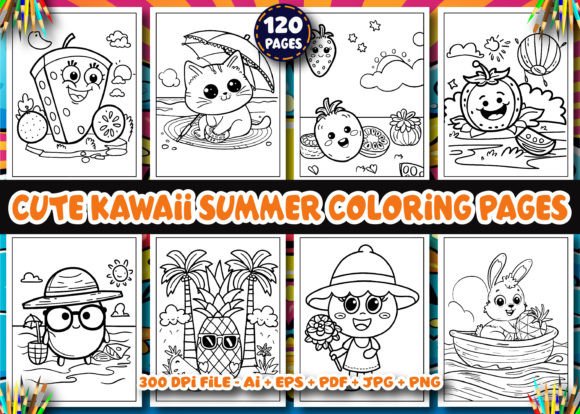
120 Cute Kawaii Summer Coloring Pages: A Versatile Digital Asset for Creators, Educators, and Entrepreneurs
Within the rapidly expanding ecosystem of digital creative resources, 120 Cute Kawaii Summer Coloring Pages stands out not merely as a themed collection—but as a strategically designed, production-ready toolkit. This bundle delivers more than seasonal charm; it offers functional flexibility across multiple professional domains, from self-publishing workflows to classroom enrichment and small-business product development. Its value lies in how thoughtfully its technical specifications align with real-world operational needs—especially for those navigating print-on-demand (POD), Amazon KDP publishing, or custom design services.
Why Format Diversity Matters in Practice
The inclusion of Ai, EPS, PDF, JPG, and PNG files—all at 300 DPI and sized precisely to 8.5″ × 11″ without bleed—is not an arbitrary feature list. Each format serves a distinct role in different stages of creation and distribution:
- AI and EPS files empower designers and publishers who need full vector editability—adjusting line weights, isolating elements for layered coloring effects, or repositioning kawaii motifs (like smiling suns, watermelon slices, or flip-flop-wearing bunnies) to match brand guidelines or series continuity;
- PDF files streamline KDP interior uploads: no scaling errors, no color profile mismatches, and guaranteed compatibility with Amazon’s automated preflight checks;
- JPG and PNG files serve immediate use cases—social media previews, website thumbnails, educator handouts, or mockups for Etsy storefronts—without requiring design software;
- The consistent black-and-white, high-contrast line art ensures optimal ink coverage on home printers and commercial presses alike, reducing grayscale smudging or faint-line issues common in low-DPI or RGB-converted assets.
This multi-format architecture eliminates bottlenecks. A teacher preparing summer camp materials can drop a PNG into Canva in under 30 seconds. A KDP publisher building a 160-page anthology can batch-import AI files into InDesign, apply uniform margins and page numbers, then export a single press-ready PDF. An illustrator offering custom cover design services can extract and stylize individual kawaii elements from the EPS set to create cohesive branding across interior and exterior assets.
Real-World Applications Beyond Coloring Books
While marketed as a Cute Kawaii Summer Coloring Book For Kids, the utility of these 120 pages extends far beyond traditional coloring book boundaries. Their intentional simplicity—clean outlines, generous white space, expressive yet uncluttered compositions—makes them adaptable across contexts where visual clarity and emotional resonance matter.
Educators integrate kawaii-style illustrations into literacy and social-emotional learning activities. A “summer feelings chart” might use a kawaii ice cream cone labeled “excited,” a sleepy sloth holding a beach ball for “relaxed,” or a blushing starfish for “shy.” The familiarity and warmth of kawaii aesthetics lower affective filters for young learners, especially those with anxiety or language acquisition needs.
Therapists and counselors use similar imagery in directive art interventions. Drawing within pre-drawn kawaii frames reduces decision fatigue for clients experiencing executive function challenges. The playful motifs also serve as non-threatening entry points for discussing themes like transition (e.g., a kawaii turtle carrying summer items on its shell), sensory regulation (a calm jellyfish floating underwater), or identity (a customizable kawaii avatar wearing culturally specific accessories).
Small business owners repurpose individual pages as printable party kits—think kawaii-themed scavenger hunt clues, cupcake toppers, or “build-your-own-sandcastle” activity cards. Because all files are commercially licensed for resale, a craft shop owner can legally include select designs in a summer workshop kit sold on Shopify or at local markets—no attribution required, no royalty obligations.
Strategic Advantages for KDP and POD Publishers
For creators leveraging Amazon KDP or other print-on-demand platforms, the 120 Cute Kawaii Summer Coloring Pages bundle directly addresses three persistent pain points: time-to-market, interior consistency, and scalability.
First, time-to-market shrinks dramatically. Instead of commissioning original illustrations—which can take weeks and cost hundreds per page—publishers gain instant access to a complete, thematically unified interior. With 120 pages, they can launch a standard 124-page book (including title, intro, and credits) in under 48 hours after acquiring the bundle.
Second, interior consistency is baked in. Unlike crowdsourced or AI-generated sets that vary in line weight, spacing, or motif density, this collection maintains visual harmony across all pages. A child progressing from page 12 (a kawaii flamingo sipping lemonade) to page 97 (a kawaii octopus juggling seashells) experiences coherent stylistic rhythm—a subtle but critical factor in perceived quality and repeat purchases.
Third, scalability is inherent. The editable vector files allow publishers to create derivative works: a “Kawaii Summer Mazes” spin-off (using the same characters as maze anchors), a “Kawaii Summer Dot-to-Dot” version (converting outlines to numbered sequences), or even bilingual editions (overlaying Spanish or French labels onto existing scenes). Each variation reuses the core asset while targeting new search terms—Cute Kawaii Summer Coloring Pages in Spanish, Kawaii Summer Maze Book for Kids, etc.—without licensing overhead.
Design Integrity Meets Commercial Practicality
What distinguishes this collection from generic clipart or low-effort AI outputs is its adherence to kawaii design principles—not just as aesthetic decoration, but as functional communication. True kawaii relies on deliberate simplification: enlarged eyes for empathy cues, rounded contours to signal safety, and intentional asymmetry (e.g., a lopsided sunbeam or crooked smile) to evoke handmade authenticity. These aren’t decorative flourishes; they’re cognitive accessibility features.
Observe how the kawaii watermelon slice avoids realistic seed placement—it uses three bold, evenly spaced black circles instead. That choice improves scannability for early readers and reduces visual noise during coloring. Similarly, the kawaii beach umbrella doesn’t render fabric texture; its striped pattern uses thick, parallel lines spaced for easy crayon coverage, not photorealism. These decisions reflect an understanding of both artistic tradition and practical usability.
That integrity transfers directly to market performance. On Amazon, coloring books with strong thematic cohesion and age-appropriate line work consistently outperform generic “summer” collections in conversion rates—even when priced identically. Buyers recognize intuitive design intuitively: clean lines translate to less frustration, consistent character styling builds series loyalty, and recognizable kawaii tropes trigger emotional recall (“This feels like the books my cousin loved last year”).
Implementation Considerations for Diverse Users
Despite its plug-and-play appeal, successful integration requires attention to context-specific constraints:
- For educators: Verify district copyright policies before distributing digital files to students. While the license permits classroom use, some institutions require centralized file hosting rather than direct student downloads;
- For KDP publishers: Avoid overloading interiors with excessive text. Kawaii’s strength lies in visual storytelling—adding lengthy instructions or prompts may dilute the aesthetic and increase production costs without improving engagement;
- For designers offering cover services: Use the included kawaii motifs as compositional anchors—not literal centerpieces. A compelling cover might zoom in on a single kawaii element (e.g., a pair of sunglasses reflecting palm trees) rather than arranging all 120 pages into a collage;
- For therapists: Consider modifying complexity based on client needs. The EPS files allow easy removal of background details (e.g., deleting sand textures to reduce visual load) or adding tactile elements (e.g., dotted lines for tracing practice) using basic vector tools.
These considerations reinforce a broader truth: the 120 Cute Kawaii Summer Coloring Pages bundle functions best not as a static product, but as a foundational layer—one that gains meaning through thoughtful adaptation to audience, medium, and intent. Its longevity stems from that balance: rigorous technical preparation paired with open-ended creative potential.
Future-Proofing Through Modularity
As digital publishing evolves—toward interactive PDFs, AR-enhanced print products, or generative personalization—the modularity of this bundle becomes increasingly valuable. Each kawaii scene exists as an independent unit, easily extracted, resized, animated, or recombined. A developer could build a simple web app that lets children drag-and-drop kawaii summer elements onto a virtual beach background. An edtech startup might embed audio pronunciations into SVG versions of each page for ESL learners. Even without coding, users can leverage free tools like Google Slides to convert PNGs into clickable flashcards or sequencing activities.
In essence, the 120 pages form a semantic library—where visual vocabulary (sun, surfboard, popsicle) meets emotional grammar (joy, rest, curiosity). That duality ensures relevance regardless of platform shifts. Whether printed on matte paper in a KDP paperback or rendered in neon gradients for a Gen Alpha TikTok tutorial, the core kawaii language remains legible, warm, and inviting.